
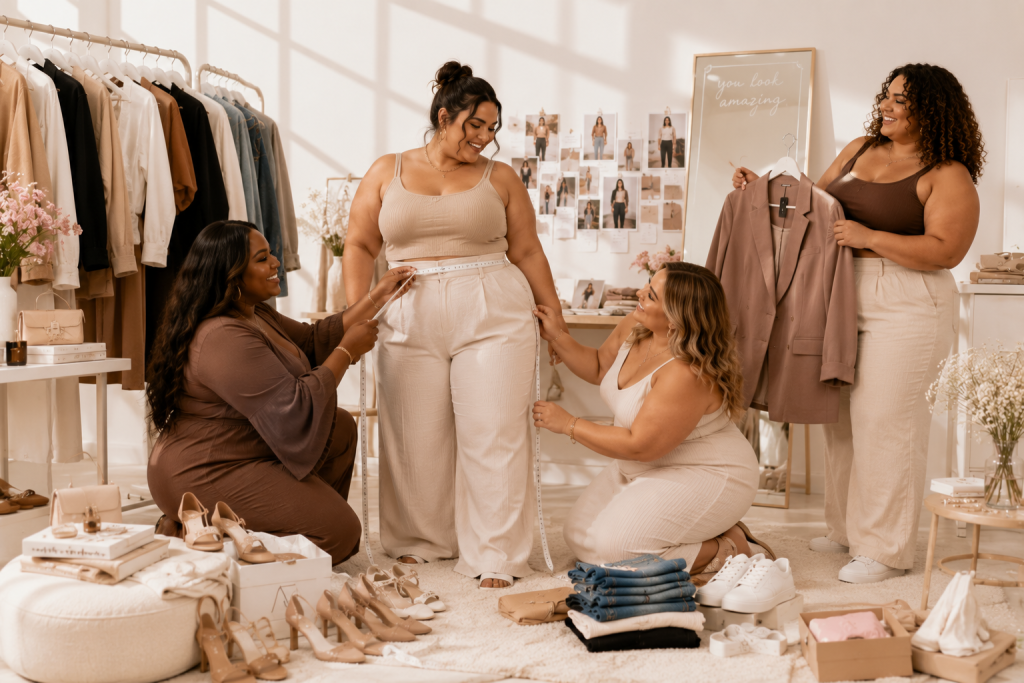
Everything you need to order plus size from SHEIN and have it fit — how to take the three measurements that matter, how to read a size chart that changes on every product, and how to use other shoppers’ bodies as your fitting room.
Once you know the labels are running about two sizes below what you’re used to, the obvious question is what to do about it. The answer is not “always size up.” That works until it doesn’t, and then you have the opposite problem in a different pile.
What actually works is switching the whole thing from letters to numbers. Below is the full method, in the order you’d use it.
1. The three numbers that replace your size
Everything downstream depends on these, so it’s worth doing once and doing it properly. You need a soft tape measure and about five minutes.
- Bust. Around the fullest part, tape level all the way round and flat against your back. Wear the bra you’d normally wear with the kind of clothes you’re buying — it changes the number more than people expect.
- Waist. The narrowest part of your torso, usually just above the navel. Don’t suck in. The measurement is only useful if it matches the body that will wear the garment.
- Hips. The fullest part, standing with feet together. Take it lower than feels natural — most people measure too high and end up with something that won’t go over.
Two habits that make the numbers reliable: keep the tape snug but never tight enough to dent, and measure standing in front of a mirror so you can see the tape is level at the back.
🔥 Do this before you close this page
Write the three numbers in your phone notes right now, titled something you’ll actually find later. Every future order becomes a thirty-second comparison instead of a guess, and you’ll never have to hunt for the tape measure again. This single step is the difference between the method working and it staying a good idea.
1.1 Measure twice a year, not once
Bodies change, and a chart comparison is only as good as the numbers going into it. Re-measuring every six months, or after any noticeable change, keeps the whole system honest. An old measurement produces confident, wrong answers.
2. Reading a chart that isn’t the same twice
There is no universal Curve chart. Each product page carries its own, and the numbers genuinely move between items — two dresses labelled 2XL can be built to different measurements.
The chart lives in the Size & Fit section on the product page, and it usually holds more than one kind of number:
| Type | What it describes | How to use it |
|---|---|---|
| Body measurements | The body the size was cut for | Match your three numbers here first |
| Product measurements | The garment itself, laid flat | Shows how much ease the piece has |
| Model measurements | The body in the photos | Close to yours? The photo is a preview |
2.1 When your three numbers disagree
This happens constantly and it’s not a problem with you — most bodies don’t sit in one column. The rule is simple: size to the largest measurement, then deal with the excess.
A garment too big in the waist can be belted, tailored, or simply worn. A garment too small anywhere cannot be fixed. When the numbers pull in different directions, follow the biggest one.
💡 Which number leads depends on the piece. For a fitted dress, prioritise whichever measurement the silhouette hugs. For a skirt or trousers, hips and waist decide it and the bust is irrelevant. For a loose top, bust is the only one that really matters.
3. Fabric changes the answer
The same chart on the same body gives a different result depending on what the garment is made of. Check the composition before you commit to a size.
| Material | Margin | Between sizes |
|---|---|---|
| Elastane, spandex, jersey knit | Generous | Your measured size usually works |
| Denim, twill, structured weaves | None | Go up |
| Swimwear and lingerie | Minimal | Go up, and measure again first |
| Coats and outerwear | Needs extra | Go up to leave room for layers |
A dress with 5% elastane forgives an inch. A pair of rigid jeans forgives nothing, and that inch is the whole difference between wearing them and not.
4. Using other people’s bodies as a fitting room
With more than 75,000 pieces in the Curve and Plus range, no guide can cover individual items. The reviews can, and for plus size shopping specifically they’re the most valuable thing on the page.
How to read them properly:
- Filter to photo reviews first. Written feedback without an image tells you far less than one picture of the garment on a real body.
- Find reviewers near your measurements. Many list height and size. Someone within an inch or two of your numbers is worth more than fifty generic five-star ratings.
- Search the text for fit language. Phrases like runs small, true to size, had to size up repeat constantly and are usually accurate in aggregate.
- Watch for the specific complaint. “Tight across the chest” or “short in the body” tells you exactly where the pattern is cut narrow, which the chart won’t.
- Ignore the star average. It measures satisfaction with price as much as fit. The photos measure fit.
Check which range you’re in. Regular SHEIN sizing and the Curve range are built on separate systems, and some listings sit in one while similar items sit in the other. A large in the regular range is not equivalent to a 0XL in Curve — confirm before adding to cart, because this catches experienced shoppers too.
5. The order that actually goes right
- Open your saved measurements.
- Open Size & Fit on the specific product — never assume it matches the last one.
- Compare your three numbers to the body measurements column.
- Check the composition and adjust for stretch or the lack of it.
- Read three photo reviews from people near your size.
- Size to your largest measurement when the numbers disagree.
Six steps, about two minutes once you’ve done it twice. That’s what stands between an order that works and one that goes in the pile.
6. Frequently asked questions
Should I just always size up?
No. It works on rigid fabrics and fails on stretch, where it leaves you with something shapeless. Let the composition decide rather than applying one rule to everything.
My bust and hips fall in different sizes. Which wins?
The larger one, adjusted for what the garment is. Excess can be worn or altered; a piece that won’t close cannot be rescued.
Do I really need to measure, or can I estimate?
Estimating is what produces the wrong-size pile. The measurements take five minutes once and then serve every order after that.
Is the site’s fit finder reliable?
It’s a reasonable starting point, but shoppers widely report it missing on individual items. Use it as a suggestion and let the product chart plus photo reviews make the final call.
How far does the Curve range go?
Labels run from 0XL to 5XL. Because the scale sits below standard US plus sizing, the top of that range lands closer to a US 22 than the number suggests.
Why do two items in the same size fit differently?
Because each product carries its own chart and its own fabric. Same label, different cut — which is exactly why the chart on the page beats the label every time.
7. In short
Measure once and save the numbers. Read the chart on the actual product. Let the fabric adjust the answer. Borrow a fitting room from someone your size in the reviews. Size to your largest measurement when they disagree.
That’s the whole thing. Not a trick, not a workaround — just the information that was always on the page, used in the right order.
⬇️ Open SHEIN’s official size guide and measuring instructions ⬇️
Disclosure
Fincroas is an independent publisher. We are not affiliated with, endorsed by, or sponsored by SHEIN. SHEIN, SHEIN Curve and related marks are trademarks of their respective owner. We do not sell clothing, hold inventory, or process orders.
No guarantee
Size charts, fit and product ranges vary by item and can change at any time. The guidance here reflects publicly available sizing information and widely reported shopper experience at the time of writing, and is general advice rather than a promise of fit. Always check the size chart on the specific product page before ordering.
Advertiser disclosure
This site may display advertising or receive compensation through commercial relationships. Compensation may affect where commercial material appears but does not give advertisers approval over our editorial content.
Editorial note
This article is general information only. It is reviewed for accuracy and corrected when errors are identified. Readers should verify time-sensitive details with the original source.